
 (The feature image is, of course, Plato raising a finger in The School of Athens.)
There is this peculiar trend that people who study more tend to silence themselves more. Industry speaks louder than academia, undergraduates tend to be more vocal than postgraduate students, and I suspect most professors and researchers hardly want to part their lips unless when presenting their topics or when teaching. My experience is somewhat parallel: I had a lot of things to say in the summer, but since school started, nothing had come out – not publicly at least – despite having a head abuzz with ideas. Why is this happening?
Is university stifling our voices? No. Universities can hope nothing more than their members actively putting voices and research out. Whether the universities create an enabling environment for that varies across institutions (and I will argue, faculties,) but at least that objective is universal.
Is heavy workload in the way of presentation of work/thoughts? Perhaps – it does take time to put work to thoughts and present them. But here we are talking about horizons of months or even years, but not weeks. I am not sure if that is the principal hurdle.
Why is it, then, as duration of study increases, the duration between each heard opinion widens in response? There are a few guesses:
1. We are intimidated by how much we don’t know. The more you study, the more you know you don’t know. An increase in knowns will always be complemented by an increase of the known unknowns (see post “How to Know What You Don’t Know”). It makes sense that a relatively ignorant undergrad is more emboldened by his/her knowledge than someone who know a lot more.
2. Scholars have too much quality assurance on opinions The culture of scientific research requires publication of knowledge to be well-document in references, which will then be under scrutiny of the public and the scholarly community. This is a checks and balances against plagiarism and unsound data sources and citation – a great thing in published research which will then (hopefully) be used by other researchers in advancing their work.
The problem is, I think, that good researchers are applying the same stringent requirements to their other opinions, which is untimely, and unnecessary.
No, that does not mean that we should not examine what we say. I should know – my rather careless opinionated self has landed me in sticky situations. In the first year of university, I pointed at a presentation slide in a lecture and said “bullshit”. The slide was showing the UN Declaration of Human Rights, and my lecturer wouldn’t have any of my rudeness. I was asked to get out of the class, though I kept myself planted on the chair. We had a chat later, and the lecture advised me to study a lot more before assuming the credibility to critique with such rough language. I took the last part by heart – until this post, I have not used the word in any scenario since then (“nonsense” is a good alternative.) Unfortunately, I never did learn to keep my mouth shut. Now that I think of it, my lecturer might have mentioned that in her recommendation letter… Good job, Natasha.
In February of 2017, I attended a conference open lecture by an economist who apologized on stage for not having predictions from his economic models come true. This past week I witnessed my professor, Prof J. Marchand taking apart a publication during his public lecture on Alberta’s minimum wage. As he took out the writing that attacked him and read out the problematic pieces, I couldn’t help but shudder. No, the piece calling his work “fundamentally flawed” was not from me. But it is nonetheless chilling seeing how academic conversations take place beyond a journal, and how one’s publication serves as a proxy for his or her professional reputation.
You may think that this is a good call to be more careful in publications. I think not. Prof Marchand’s commentary criticizing the 40% minimum wage increase was not published until 1 year after its completion, and that’s already half way through the minimum wage policy’s 4 years staged implementation. It was also said that the effect of the minimum wage increase, which will complete the last stage of increase tomorrow, cannot be ascertained until a good study comes up – perhaps 2 years from now (assuming a speedy approval and publication process of the study. )
2 years.
That is almost half a political office term. A lot of things can be said and unsaid, done and repealed. Donald Trump could have severed ties with half of the countries in the world, even if he has to do it one at a time. Brexit will….still be in talks. But never mind. Hundreds of thousands of labour and businesses could have, and have already been, affected by the minimum wage increase and its complementaries. If a commentary or short study had come out earlier, would there have been more media coverage, provoking some kind of civil response against the government’s questionable policy? Would it have changed the election results?
2 years.
That is how long it takes to examine all literature, get credible data, examine every element in the models, test alternative structures, write, and get published. The last part is the greatest hurdle, for journals are not known to be quick action takers. And, as an apparently non-partisan think-tank promptly shows, its impact can quickly be diminished with articles put together with poor claims and a clear lack of understanding of numbers written by just about anyone. This turnaround time is hurting us. The minimum wage promise got a political party elected in 2 months. Are new economists trained to simply do what they like to do, that is positive analysis of the economy? Or should they be responsible in using their analysis to influence policy making? I feel that economists should be taught not only to write proper research papers, but also to talk, at the right time. It doesn’t matter if an economist intend to focus only on the “why’s”, but his or her education should include telling the “how’s”.
UPDATE:
The commentary remains the only scholarly piece on the massive minimum wage increase. In a market swarmed with labour studies, that is. Interest in doing socially impactful piece seemed to diminish even further in view of this controversy and attacks on Prof. Marchand. My professor is a badass.
p.s. Amidst this academic-clad atmosphere there is a (harmful) oasis. For me, it is debating. It is liberating: you prepare arguments and draw causal links. You deduce. You use dialectic and reason, but do away with figures and citations. Debating is performative: you ought to present your arguments taking into accounts how they will be perceived. It is exhilarating: instead of 15 years, you are given 15 minutes to prepare a case. It is strategic: there are only 7 minutes to speak so you can choose only the arguments that may win you the round.
It is also painful because I don’t love to face my weaknesses in dialectics, and for each hour of debating I lose an hour of sleep. So it’s been a love-hate relationship — but guess who won Grant Davy’s this weekend!
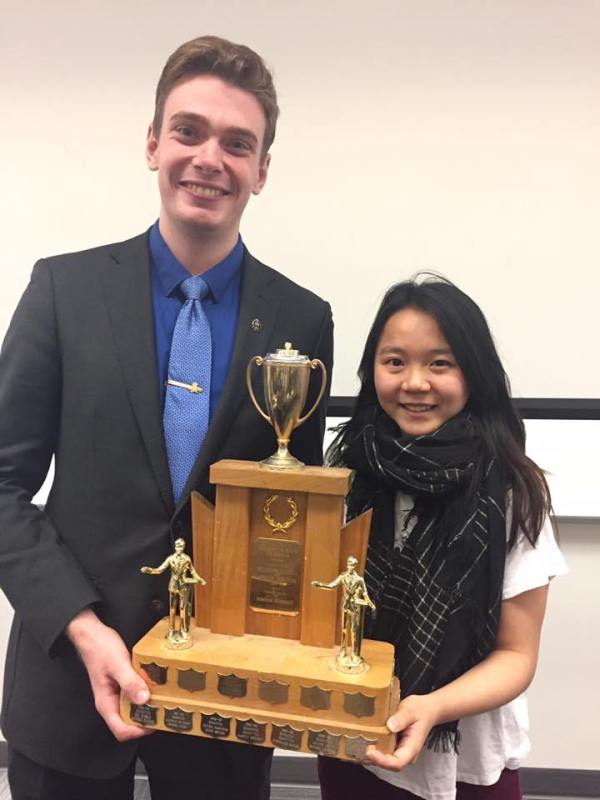
Boast over.
Written by Natasha. Last edited:2018-09-09 11:09:14