
Last semester was my first semester after transferring into upper sophomore year at the University of Alberta. I have learnt a lot in the classroom, in office, and outside, but this post is strictly about what I learnt about studying in a campus setting. This is most relevant to the study of economics/other social sciences, but may not apply to other disciplines like engineering or fine arts.
YOU DON’T KNOW WHAT YOU DON’T KNOW
This is an actually useful tautology. As you study and learn, keep in mind that you simply don’t know what you don’t know. The classic question: if a tree falls in a distant forest, and no-one hears it, did the fallen tree make any noise? For me, as far as my personal domain is concerned, an unknown matter does not exist.
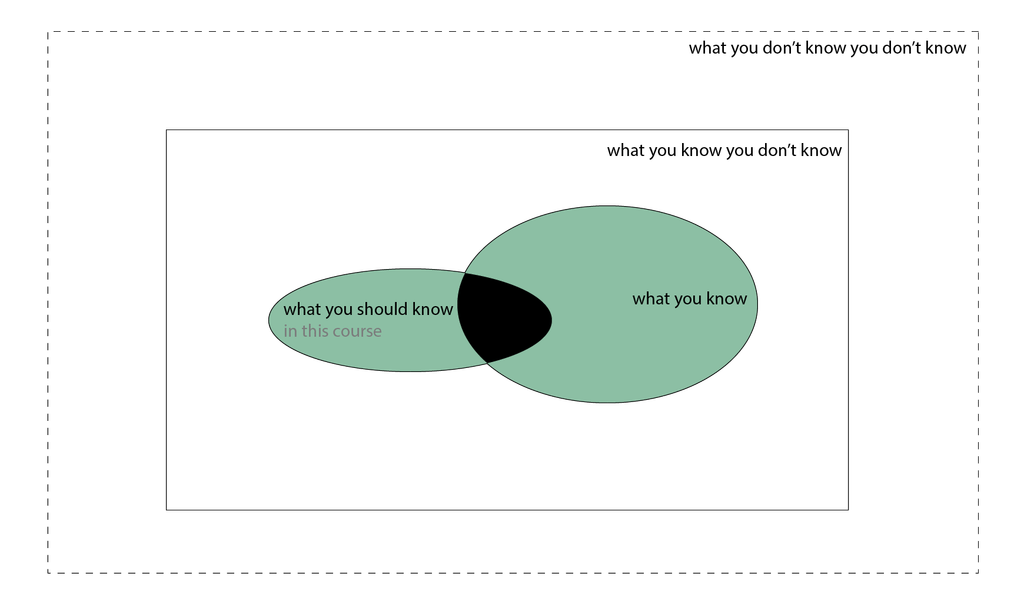 Venn diagram: You don’t know what you don’t know
Here’s what you know and don’t know. Dotted lines because what you don’t know is infinity! As a result, you may be surprised, after a year or an undergraduate degree of intense study into the matter, that it rests on a few assumptions that you come to doubt. Here’s a less severe example: last semester, my microeconomics professor taught the class the price = marginal cost or marginal revenue = marginal cost condition in the marginal productivity theory of distribution. He half-threatened:
Keep this in mind. After many years when you’re old, I’d call and ask ‘how to maximize profits ina competitive market?’ and you’d have to tell me MR = MC.
Indeed, I kept that in mind until after final exam.
It was irresponsible, but I was in luck. I found out later in the summer that there is a whole world outside of marginal approach to microeconomics analysis. Marginalism did not come into use until late 1900’s during the marginalism revolution, and the marginal productivity theory of distribution is not until John Bates Clark in 1899 (I. H. Rima, 2001, p.282). In class, we were led to question the 3 neoclassical assumptions of consumer rationality, but not Clark. My professor obviously has faith in the approach’s dominance for at least another few decades, and indeed the approach is deeply entrenched in the field, but this promise warrants certain skepticism.
What I learnt: Always endeavour to find out the underlying assumptions to a claim. You may not be able to dig into the origins of everything, but knowing what your courses’ central arguments rest on is a great mental insurance. No nasty surprises == good. Also, see my post on how to know what you don’t know!
TIME IS A RESOURCE & MEASUREMENT METRIC – OPTIMIZE IT.
I don’t want to spend all my time studying, and missing out on what I can otherwise see, learn and build. But there is immense pleasure in learning about things and achieving goals. It’s a dilemma.
Wonder how much to study? Here’s one method – just measure the time you put into studies. Most students would have heard of a rule of 2.5x. Say, if a 3 credits courses means 3.0 contact hours (sans lab) per week, you should put in 2.5 * 3.0 = 7.5 hours into (really and actually) studying for that course that week. It follows that a 15-credits full load semester would be 37.5 of studies + 15.0 lecture hours = 52.5 hours of commitment.
Then add your other commitments e.g. student group activities, volunteering, part time job, friendship, exercises, etc. Then, optimize.
Want less hours on studying? Absolutely. Think about it – surely you won’t need 13 hours for each of your courses. Say if you are stronger in the macro side, or if you have taken some other courses that require less attention, you can use it for the harder subjects, and/or in fact, just cut down on the hours! Then you can yes to the weekend trip.
What I learnt: Use the 2.5x rule, but fit it to your needs.
DIP A TOE INTO EVERYTHING.
It is wonderful that in undergraduate years, everything comes together. Even if you’re set on a study field (say you’re.. neurology for life?)- try everything! What you learn in one class is very likely to integrate into another – even if it is in a different discipline; if you are lucky and observant, you’ll notice that it helps in your professional work too.
The trade-off is, of course, you will have less time to go deeper into any particular one. This is when you actually use the Diminishing Returns rule. I will post more on the graphing side, but meanwhile, consider these common grades and what they mean:
| Grade | Student be like |
|---|---|
| [C:] | (C or below) not sure what I’m doing |
| [C+, B-] | have a moderate grasp of the course materials (know the terms, definition etc.), but cannot spin on it and answer most questions right. |
| [B, B+] | understand most of the materials; but have not practised or implemented the learnings. |
| [A-, A] | understand the material quite well. |
| [A+] | proficient with the materials AND can formulate great answers to the questioning and grading style by the particular grader. |
In my opinion, if you are an aspiring learner and this is a core subject, A- and A should be good. Anything above that would mean that you’re using a lot of energy training to fit the course but not necessarily the subject matter. Of course, if you are a scholar then that’s a different matter…
If you’ve been forced into a course, or enrol in one that you do not at all enjoy, by all means, drop it or aim for B and below. The cost of your going after a good grade for that course is all the learnings that you can accumulate using that time. A course that does not help you go where you want to go does not justify the cost.
What I learnt: In order to learn more, one should only do the minimum (or optimum – but more on that later.)
ALWAYS BRING YOUR RUBBER.
This followed an unfortunate incident. I learnt that, in North America, always bring your rubber to an exam. There is usually no multiple choice questions, but there will be emergencies and needs. Always double check that you have a rubber before going in. Or you’d have to raise your hand in the middle of an exam and ask for a rubber.
Don’t.
What I learnt: say “eraser”. Apparently a rubber made of rubber is not meant to rub things.
Reference
- Rima, I. Hahne. (2001). Development of economic analysis. 6th ed. London: Routledge.
Written by Natasha. Last edited:2018-09-09 09:12:34